

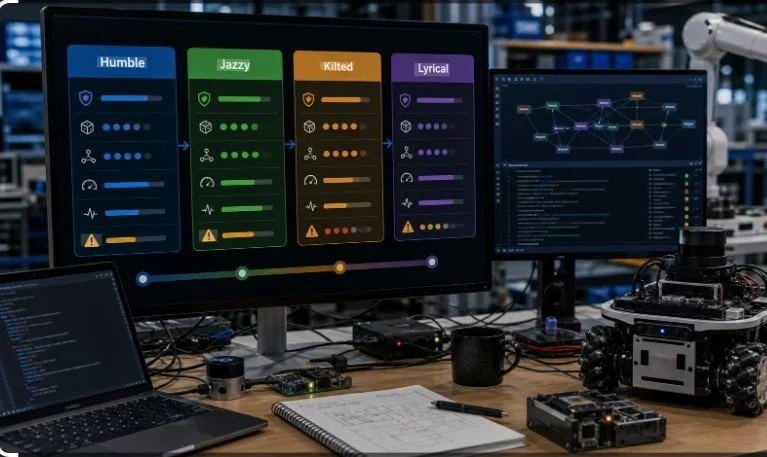
The robotics industry is massively advancing faster than ever. From autonomous mobile robots and warehouse automation to AI-powered service robots and educational platforms, modern robotics projects have become increasingly sophisticated. Behind many of these innovations is one technology that has become the backbone of robot software development—the Robot Operating System (ROS).
Today, ROS robotics has evolved from an academic research framework into the world's most widely adopted robotics software ecosystem. Developers, universities, startups, and global manufacturers rely on ROS because it provides a standardized way to build, test, and deploy robotic applications efficiently. Open Robotics describes ROS as an open-source software development kit that accelerates robot development through reusable tools, libraries, and community-driven packages.
What Is the Robot Operating System?
Despite its name, the Robot Operating System isn't actually an operating system like Windows or Linux. Instead, it is a flexible software framework that provides everything needed for building robotic applications.
ROS includes:
· Hardware abstraction
· Device drivers
· Communication between software components
· Sensor integration
· Motion planning
· Visualization tools
· Simulation support
· Thousands of reusable open-source packages
Rather than writing every robotic function from scratch, developers can combine existing ROS packages into modular systems. This dramatically reduces development time while improving reliability and scalability.
Why ROS Has Become the Industry Standard
The widespread adoption of ROS robotics isn't accidental. Several factors have made it the preferred platform across research, education, and commercial robotics.
Massive Open-Source Ecosystem
ROS has one of the largest robotics communities in the world. Developers contribute thousands of packages covering navigation, SLAM, perception, manipulation, machine vision, AI integration, autonomous driving, and much more.
Instead of reinventing solutions, teams can build on proven software.
Modular Architecture
ROS applications are built around independent "nodes" that communicate using standardized topics, services, and actions.
This modular design makes it easier to:
· Replace components
· Scale projects
· Debug individual modules
· Reuse software across different robots
Cross-Hardware Compatibility
Whether you're building a robotic arm, autonomous vehicle, warehouse robot, drone, or educational robot, ROS supports an enormous range of hardware.
Manufacturers continue releasing ROS-compatible drivers, making integration significantly easier than proprietary alternatives.
ROS 2 Improves Commercial Deployment
The transition to ROS 2 has made the framework even more suitable for industrial applications.
ROS 2 introduces:
· Better security
· Real-time communication
· Improved reliability
· Multi-robot support
· DDS-based communication
· Long-term maintainability
These improvements have helped ROS move beyond research laboratories into production environments across manufacturing, logistics, healthcare, agriculture, and autonomous systems.
The Biggest Challenge with ROS Programming
Although ROS is incredibly powerful, getting started has traditionally been difficult.
New developers often spend days configuring:
· Ubuntu Linux
· ROS installation
· Dependencies
· Docker
· Package management
· Networking
· Development environments
Even experienced engineers frequently lose valuable time setting up development environments before writing their first line of robot code.
This complexity can slow learning, increase project costs, and create unnecessary barriers for students, educators, and development teams.
How MiROS Simplifies ROS Development
MiROS was built specifically to remove these barriers.
Instead of spending hours configuring Linux virtual machines and software dependencies, MiROS provides a browser-based visual development environment for ROS that works across Windows, macOS, and Linux. It combines visual programming with automatic code generation while still allowing developers to edit the generated C++ or Python code directly when needed.
Some of the major advantages include:
Visual ROS Programming
MiROS allows developers to build ROS nodes, topics, services, and package structures using intuitive drag-and-drop tools.
As the visual workflow is created, MiROS automatically generates the underlying ROS code.
This significantly reduces syntax errors while helping new developers understand ROS architecture much faster.
Cloud-Based Development
MiROS runs entirely in the cloud.
Developers no longer need to maintain complicated local ROS installations or Linux virtual machines. Projects remain synchronized online, allowing teams to work from almost any computer with a web browser.
Faster Learning
Educational institutions increasingly face challenges teaching ROS because students use different operating systems.
MiROS eliminates lengthy installation sessions, allowing students to begin programming in minutes rather than spending an entire class configuring software. The platform also includes templates and certified training resources to accelerate learning.
Built for Beginners and Professionals
Beginners benefit from visual programming and ready-made templates.
Professional developers can switch seamlessly into the integrated code editor to customize every aspect of their applications.
This hybrid workflow provides flexibility without sacrificing productivity.
Why ROS Will Continue Leading Robotics
Robotics is becoming increasingly connected with artificial intelligence, computer vision, edge computing, and cloud robotics.
ROS continues evolving alongside these technologies by providing standardized communication between increasingly complex software systems.
As robots become more autonomous, modular software development becomes even more important. ROS enables teams to integrate AI models, perception systems, navigation stacks, manipulators, and cloud services without rebuilding core infrastructure.
That flexibility is one of the biggest reasons ROS remains the preferred robotics framework in 2026.
The Future of ROS Programming
The future of robotics development isn't just about writing code—it's about building software faster, collaborating more effectively, and reducing technical barriers.
Tools like MiROS represent the next evolution of ROS programming, making advanced robotics development accessible to students, researchers, startups, and enterprise engineering teams alike.
By combining visual programming, cloud accessibility, automatic code generation, and full compatibility with modern ROS workflows, MiROS helps developers spend less time on setup and more time building intelligent robots.